


June 6th - July 11th - August 22th - September 12th - October 3th
Cervia
Discovering the Duca d'Altemps Woods

Once again this year, the beautiful ecological walks to discover the "Bosco del Duca d’Altemps" (Duke d’Altemps Woods) will take place in Castiglione di Cervia.
The guided tours are free and open to everyone; they will be curated and led by Alteo Missiroli, a painter, environmentalist, and Voluntary Ecological Guard. The walks are designed to help participants discover the fascinating natural landscape of the woods and its history. During the visits, the area’s captivating natural treasures will be showcased, along with the story of Dr. Alberto Missiroli, who was born in Castiglione and became a world-renowned scientist and researcher famous for his battle against malaria, as well as the story of his father, Paolo, who was also a great doctor and a friend and advisor to the village for over forty years.
Following the walk, there will be a release of birds of prey that have been rescued and rehabilitated by the wildlife recovery center “Associazione Zoofila Amici degli Animali” of Ravenna.
Programm 2026:
Evening visit: The Duke’s Fireflies
From 8:30 PM to 10:30 PM
Saturday, July 11
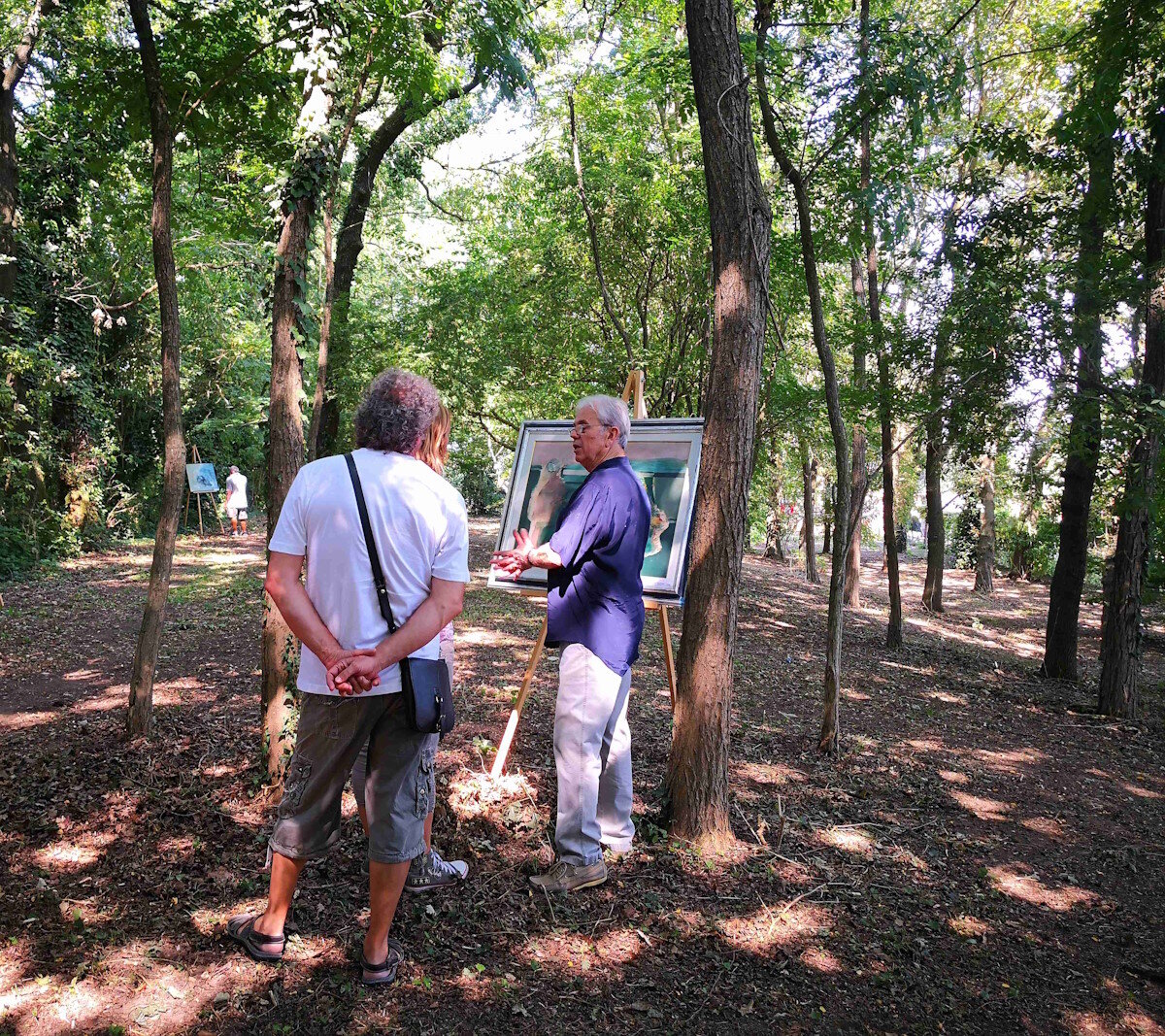
En plein air painting exhibition "A painting for ecology and world peace" by Alteo Missiroli
In a suggestive natural setting, where the landscape takes on a dreamlike dimension, capable of evoking deep emotions and inviting the viewer to reflect on the future, with a hopeful gaze turned towards what may be.
Saturday, August 22
From 5:30 PM to 6:30 PM
Saturday, September 12
From 5:30 PM to 6:30 PM
Saturday, October 3
From 5:30 PM to 6:30 PM
These walks are part of the "Cervia Città Giardino" (Cervia Garden City) program.
Biographical notes: Alteo Missiroli, painter, environmentalist, and Voluntary Ecological Guard, is a man deeply connected to his land. A sensitive and attentive observer of his surroundings, his works depict the contemporary world and its reality, in a continuous search for the essence of the elements that express the relationship between man and the environment. Missiroli’s art should be understood as an evolutionary journey, begun fifty years ago, in which the artist conveys his interpretation of the world through his painting style and use of color. Missiroli focuses specifically on the environment, the landscape, and the impact of human actions on nature. In the early period of his painting, the artist expressed—as a form of protest—the ecological problem caused by human intervention, which is often destructive in the name of progress; he achieved this through the use of geometric shapes and bold colors that energetically convey a sense of pain. In his more mature period, Missiroli describes the landscape in its beauty and delivers a message looking toward the future, suggesting that from there—from that beauty—we must start again to find a new balance between man and nature. This message of hope is evoked by Missiroli in works that describe the landscape in which he lives (salt pans, sea, pine forest, woods), using soft, borderless, blended colors. The landscape appears with a dreamlike delicacy, capable of evoking emotions of beauty that invite us to look toward what is to come.
 Is it not what you were looking for? Review your choice


 Where to sleep
 Where to eat
 All the services
 How to get
 Weather forecast
 Webcam